

By Jim Graham
Hannah beat all the odds this year when she drew her elk tag, and the story that followed is one I’ll never forget.
It all started when she told me she didn’t want to hunt or even apply for elk this year. Normally, Hannah’s good for one hunt a year, and after she filled her oryx tag in New Mexico earlier this spring, she was more than happy to hang up her rifle for the season.
Between being a mom, a supportive spouse, and running full throttle in everyday life, she doesn’t have much time to do things for herself. So, another hunt in the fall wasn’t at the top of her priority list.
When I asked her if she wanted me to put her in for elk, she said flat-out she’d rather not hunt this year. Naturally, I didn’t listen. I went ahead and applied her for two of the toughest tags in the state, figuring it was better to ask for forgiveness than permission. If she happened to draw, well, that would be a good problem to have. After all, it was less than a 1% chance of drawing.

Lo and behold, when the draw results came out, my credit card got hit. It didn’t happen in the first wave of charges, but a few days later when Arizona Game and Fish charged cards again for the applicants whose credit card failed the first time. Someone else’s loss was our golden ticket.
When I saw the elk charge, I got extremely excited, I thought I had finally drawn the Arizona premium archery elk tag I’d been chasing with my 12 bonus points. I started joking that it would be hilarious if it was Hannah’s tag instead of mine. It was so unlikely, but I kept teasing her that maybe it was her name on the lucky draw.
She rolled her eyes and said it would be just her luck to draw a tag the one year she didn’t want to go elk hunting.
When the final results came out, I checked my portal first. No luck. My heart skipped a beat because that meant only one thing, Hannah had drawn.
Sure enough, her Unit 9 muzzleloader tag was no longer a dream, but a reality. I called her immediately and told her the results were posted and that I had good news and bad news. Her response, in a mix of shock and frustration, was: “I freaking drew the tag, didn’t I?”
She might have hung up her rifle for the season, but she was going to quickly become acquainted with our Arrowhead Muzzleloader.
Once I explained how incredible it really was, her tone shifted. She was excited, and nervous. Soon, the office jokes started that Hannah had the best tag of the year and would probably shoot a bigger bull than any of us ever had.
Summer came and went, and before we knew it, Hannah’s once-in-a-lifetime elk hunt was upon us. For personal reasons, we hadn’t been able to scout as much as we wanted, so my good friend Nash Clark and I headed up to Unit 9 the Monday before the opener.
Our goal was to scout hard for three days, find a target bull, and be ready when Hannah arrived.
Any early concerns about finding elk quickly disappeared. Even though the archery hunt had been slow, the days leading up to the muzzleloader opener were alive with bugles echoing through the timber. Nash and I covered a lot of ground, glassed dozens of quality bulls, and felt confident we’d have an opportunity when Hannah got there.
By Thursday afternoon, I drove back down to Phoenix, picked the kids up from school, dropped them with the grandparents, and then Hannah and I headed straight back up the mountain.
By the time we rolled into camp, it was dark. Our close friends were already in camp, all eager to help Hannah on her hunt. We sorted gear, made a plan, and tried to get a few hours of sleep before opening morning.

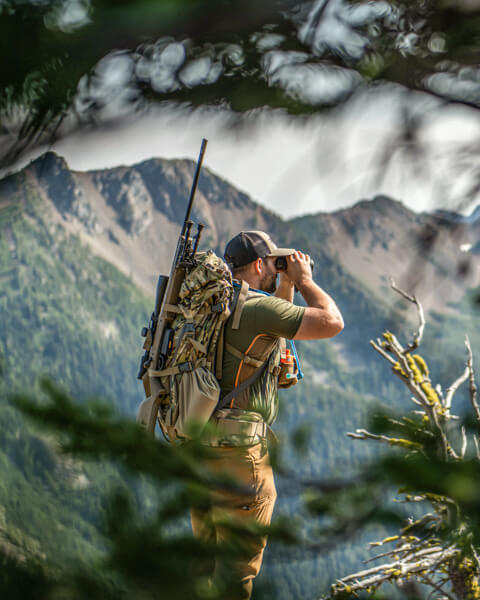
After a short drive, in the dark of the morning, we sat parked in the Polaris Xpedition with the windows down, on the edge of a burn, surrounded by bugles. As shooting light crept closer, we eased into the timber, following the taunting calls of a bull we’d spotted the night before.
This was Hannah’s first real taste of elk hunting, and it couldn’t have been more perfect. When the bull let out a deep, guttural bugle only a hundred yards away, the look on her face was priceless. She felt it in her chest, that wild sound that hooks every elk hunter for life.
We shadowed that bull all morning, catching glimpses through the thick timber but never finding a clear shooting lane. Twice more we got into elk, close calls, cows chirping, bulls screaming, but each encounter ended just out of range.
That night, bugles echoed all around us again, but still no shot opportunity. By the end of the first day, we’d hiked ten miles and chased elk nonstop. Hannah had officially been baptized into the chaos of the rut.

Tired but motivated, we changed tactics for day two. Instead of chasing bugles, we decided to glass a big basin we’d scouted earlier, an area loaded with elk activity.
Before sunrise, the basin came alive. Bugles rang from every direction. Bulls were fighting, cows were running, and the entire ridge erupted with rut energy.
It wasn’t long before I spotted a bull below us, dark horned, with great tine length. One look at his massive back end and I knew he was a shooter. I motioned for Hannah to come take a look, and then sprinted over to find Nash who was further down the ridge. By the time I got to him, he already had his hands up over his head, the universal signal for big bull.
We got Hannah over to where Nash was and set up for a possible 400-yard shot, but the bull slipped into the thick timber before she could get settled. We decided to wait him out. It was 6:30 in the morning, and we were prepared to sit all day if that’s what it took.
And that’s exactly what happened.
We listened to his raspy bugle echo from the trees all day long below us but couldn’t see him. As we made our way slowly down the mountain throughout the morning, looking for a better angle, our friends Ernie, Christian, and Jared were set up as spotters up above us for a better vantage. Sporadically we could see glimpses of cows feeding, but the bull stayed hidden. By mid-day, we were nearly out of food and water.
Then, we got a call from Ernie, the bull was finally on the move.

We hustled down the mountain, trying to intercept the herd before they disappeared into the next patch of trees. The smell of elk hung thick in the air as we crept through their bedding area, moving slow and silent.
Hannah, following Nash’s lead, got her first glimpse of the bull at about 200 yards, but just as she steadied the muzzleloader, he slipped back into the next thicket of trees.
We set up again, resting the gun in the Triclawps, waiting for him to step out. For over an hour we caught fleeting glimpses of tan hides and flashes of antler tips through the trees, but no shot opportunity was presented.
Then, our spotters called, the herd had moved out into the burn on the opposite side of the tree line we were sitting on. We looped back through the maze of fallen logs and blackened trunks, trying to cut them off. The terrain looked open from above, but on the ground it was a tangle of downed timber, a spiderweb of obstacles.
Finally, I caught movement. One cow. Then two. Then the whole herd, eight cows in total. But still no bull.
Then I saw them, antlers weaving through the burned timber. The bull had appeared. Instead of following the cows from the rear, he appeared in the middle of the herd from beyond.
He let out a deep, rolling bugle that you could feel in your chest. He was less than 100 yards away.
From my angle, I had a clear view of his vitals, but Hannah and Nash didn’t. I whispered for them to take a few steps in my direction. By the time they did, he moved again, lip curling and chasing cows, completely unaware of our presence.
Cows passed within 40 yards, but still the bull offered no shot amidst the jungle of burned trees. Finally, he stepped forward into a small opening. The muzzleloader thundered through the canyon.
A cloud of dust exploded off his body, a hit.
He stood there, dazed, looking around. As we tried to reload, the cows bolted, but the bull stayed put. Then, slowly, he turned and walked into the timber.

Reviewing the video I’d recorded, we saw that the shot had hit farther back than ideal, probably liver. Hannah had done exactly what we’d practiced for on a broadside shot, but the bull had been quartering more than we realized, and we failed to explain the proper shot placement on an angled animal.
We waited an hour and a half before easing in to where we last saw him. Our spotters confirmed he hadn’t left the patch of trees he walked into. Moving slowly, Nash and Hannah led the way, ready for a follow-up shot if needed.
Suddenly, Hannah caught movement in the trees. The bull was still alive. Before we could catch a glimpse through the binoculars, he disappeared again.
Christian called from above, the bull had moved out of the tree line and back into the burn. Heading away from us, his head down but still on his feet. He was hurt, but not done.
We took off running, leaping over deadfall, trying to close the distance. We caught glimpses of him, but never had a shot. He soon dipped into a ravine, and we knew this was our one chance before running out of daylight. He had to climb out of this depression before going into the next thicket of trees.
Hannah now set up in the Triclawps, steadied herself, and when the bull stepped up and out of the ravine offering a quartering away shot, she squeezed the trigger. The report echoed across the canyon, followed by a solid thud.
A perfect hit, breaking the front shoulder.
The bull staggered and seemed like he was about to tip over, but he kept moving slowly uphill. Another hurried shot missed, and then we found him bedded just inside the trees. Light was fading fast.
Through the brush, we could only see his upper body. Hannah took one more shot, but a log exploded in front of him. Tension was sky-high as light was quickly fading. Nash calmly reloaded and talked her through it, steady breathing, slow squeeze.
The final shot rang out.
This time, the bull slumped instantly.

I threw my hands up and yelled, “He’s dead!” The next few moments were a blur of hugs, tears, and pure adrenaline.
We were exhausted, dehydrated, and completely spent, but Hannah had done it. She had just taken the biggest elk she’d ever seen in her life. As her husband, I couldn’t have been prouder.
Even though she never wanted to apply, she rose to the occasion, hunted hard, and handled everything with grace, patience, and determination.
When we finally walked up to the bull, it was impossible not to get emotional. He was massive, a true old warrior, and Hannah’s first elk. Watching her lay her hands on those antlers for the first time was a moment I’ll never forget.
Before long, our friends started pouring in, Ernie, Christian, Jared, and Steven. Everyone was smiling, high-fiving, telling stories, and soaking it all in.
We broke down the bull and hauled him out piece by piece, finally rolling into camp late that night. Despite the hour, we celebrated with steak and laughter under the stars.
It wasn’t just a successful hunt, it was a memory made with great friends, hard work, and a lot of heart.

People often think elk hunting is about chasing trophies, but this hunt reminded me it’s really about the people. The friendships, the shared effort, the long days, and the memories made along the way, that’s the real reward.
We couldn’t have done it without our incredible team. Nash was there every step, from scouting to coaching through the final shot. Ernie, Christian, and Jared were our eyes in the sky all day long. We’re truly blessed to have friends like these.
Hannah’s once-in-a-lifetime tag turned into a story we’ll tell forever, and yes, she now proudly holds the title of biggest elk in the office.
You’d think her dream season would end there, after her oryx and now this bull, but apparently, lightning strikes twice. Because the one thing I also left out? She also drew a Kaibab muzzleloader tag later this year. I had ignored her request one more time, because really, what would be the odds of a trophy mule deer tag as well?
I stand by my motto: it’s better to ask for forgiveness than permission.
And as for Hannah’s dream season, it’s not over yet.


